Thursday, 16 February 2017

I Kant Believe it's Not Büchner: A Codex Vitae

Rejected Titles:
  • A Crapulous Creed
  • Wrongful Convictions
  • Meditations on Second-Hand Philosophy
  • Tractatus Illogico-Philosophicus
  • Thus Spoke Nastananda

Inspired by https://github.com/busterbenson/public/blob/master/Codex.md and http://terrie.me/codex/


How To Use This Document


If you are Anthichthonian:
  • Develop a habit of using the Codex as a repository for beliefs that develop throughout the year.
  • Consider doing a monthly review of whether my life is in alignment with values and beliefs. If not, should my behavior change or have my understanding and values changed?
  • Do a yearly review in January of the entire document, editing places where beliefs have changed. Expect beliefs and tactics to change — don’t hold on to them too rigidly.

If you are not:
  • Read this with the understanding that you are different than me — the way I live my life is not the way you should live yours.
  • Consider creating your own Codex Vitae. Feel free to copy anything here that is helpful.

Meta-Beliefs

  1. This purpose of this document is to capture my beliefs about the universe.
    1. It is, and they are, always incomplete and out of date.
    2. It is, and they are, always subject to revision.
  2. There are different categories of belief, which may or may not overlap.
    1. There are beliefs that I agree with on an intellectual level.
    2. There are beliefs that I accept on an emotional level.
    3. There are beliefs that I accept insomuch as I act on the assumption that they are true.
  3. The degree to which any of my beliefs are an accurate reflection of the universe is an unanswered question
    1. Most statements should be interpreted as a "best guess"
  4. Some of my beliefs are best expressed through rationality and logic. Others are better expressed as subjective opinions.
  5. Whilst I have certain beliefs and biases that exist on a subconscious level, I assert that it is possible to change any and all of my beliefs - at least to some degree - through conscious effort.
    1. This process of becoming conscious of my beliefs and modifying them is a fundamentally useful one, even in the absence of a particular end-goal.

My General Principles

  1. "Do what thou Wilt shall be the whole of the Law. Love is the Law, Love under Will".
    1. As an essential prerequisite, one must understand one's Will in the fullest sense, and that it is not equivalent to "what one wants to do".
      1. This concept can, in its simplest form, be expressed as "above all, to thine own self be true".
    2. As a corollary, one should allow others to do their Will.
  2. All authority and certainty is to be questioned.
    1. Especially my own.
    2. "All truth begins as heresy".
  3. It is better to be open to new experiences than to be closed to them.
    1. I will regret the things that I did not do more than I will regret the things that I did do.
  4. The answer to any question is, ultimately, "it's more complicated than that".
  5. The ability to act on my wishes is contingent on first accepting any situation that I encounter on it's own terms.
  6. The pursuit of knowledge for its own sake is inherently rewarding.
  7. Even if all morality is subjective, it is better not to be a dick to people.
  8. Logic and rationality are extremely helpful tools, though like any tool they have their limitations.
    1. Logical fallacies can generally be considered to be heuristics - they are often useful rules of thumb, despite being not strictly true in all senses.
  9. If it's stupid but it works, then it's not stupid.
  10. One should aim to become antifragile
    1. This is best achieved through striving to increase one's options for action
  11. One should attempt to practice doxastic commitment, living one's life in accordance with one's expressed opinions and principles.
    1. The failure of a source to practice doxastic commitment is a useful hereustic by which to discard ethical arguements and the like, even if it is not strictly logical.

Beliefs on the Nature of Reality

  1. The Map is not the Territory
    1. Our comprehension of the world within and without emerges from our perceptions.
      1. Our perceptions are subject to any number of flaws and biases.
      2. We can never be certain how well our perceptions match up to an external reality.
      3. Reality is, thus, essentially unknowable. The best we can do is to form an image of reality.
    2. All attempts to comprehend the image of reality that our perceptions give us are also subject to numerous flaws and biases.
      1. In particular, the limitations of language impact upon our ability to comprehend the image of reality.
        1. A substantial number of metaphysical problems (e.g. the sorites paradox, the Ship of Theseus, just about everything to do with counterfactuals, etc.) are artefacts of the limitations of linguistics.
    3. These attempts to comprehend the image of reality produce models, which simply and codify the image in order to aid the understanding of a part of it.
      1. No one model can fully explain the totality of the image of reality. "There are more things in Heaven and Earth..."
      2. To have complete faith in a single model, or set of models, of reality is to limit one's conception of reality to things that can be described by that model.
    4. All models are incorrect; some models are useful.
      1. Seemingly incompatible statements within different models can be simultaneously considered true if doing so is useful to our understanding of the universe.
  2. This is all to say: we may not be able to prove the existence of a world outside ourselves, or any particular thing about that reality
    1. In practice it is useful to assume reality to be - more or less - what we experience, as the alternative does not lend itself to any useful action or further train of thought.
    2. Insomuch as it is essentially impossible to falsify, the Brain in a Vat / Simulated Universe problem cannot be answered; furthermore, given the previous assumptions, it doesn't really make much of a difference.
  3. At least in principle, we have free will; even if this is not true, it is useful to accept this as being true.
  4. Strictly speaking, induction is impossible, though in practice it is useful to assume its validity.

Beliefs on Morality and Ethics

  1. Morality is essentially an aesthetic choice
    1. This being the case, morality does not necessarily need to be strictly justifiable in its rationale, as it is an essentially subjective construct
  2. Deontology is essentially flawed
    1. Divine Command Theory and moral absolutism in general are not so much philosophies as positions of intellectual surrender.
    2. Kant's Categorical Imperative can best be treated as an ethical heuristic.
  3. Consequentialism - and utilitarianism specifically - is inherently flawed, as it relies upon perfect knowledge of the outcome of any action, and on assumptions about the universal nature of any true benefit.
    1. Equally, there is value in consequentialism as an ethical heuristic.
  4. Many moral systems can be considered flawed due to a lack of doxastic commitment among their adherents.
  5. All else being equal, one should pull the lever
    1.  Pushing the fat man is morally equivalent to pulling the lever.
  6. We do not have a moral obligation to pander to Utility Monsters.

Beliefs on Science

  1. The Weak Anthropic Principle is as good an explaination for the fundamental properties of the universe as we are likely to be able to understand.
  2. The universe is not fully deterministic when viewed in its entirety
  3. Black Swan Events have a disproportionate effect on complex systems, thus it is almost certainly useless to attempt to predict the future behaviour of such a system
  4. Anthropogenic climate change is occurring and observable
  5. Micro- and macro-evolution occur in nature.
  6. Homeopathy is unlikely to be anything more than a placebo.
  7. Vaccinations do not cause autism
    1. Even if they did, the balance of harm and benefit would favour continuing to use them.
  8. Nuclear power is, in the balance of things, better than fossil fuels, though inferior to renewable energy.
  9. The Ecological Fallacy is the most insiduous assumption that exists within the sciences, and is responsible for a great deal of bad science and bad policy.
  10. Human enhancement technologies, such as nootropics, cybernetics, longevity therapies, etc. should be considered ethically acceptable, if not praiseworthy.
  11. Assuming practical concerns around safety were resolved, there are no substantive issues with germline engineering, human cloning, etc. provided that the quality of life of the offspring is not adversely affected, and that such offspring are granted the same rights as any other human.

Beliefs on Mind

  1. A collective unconscious exists on a biological level, insomuch as the nature of our neurology predisposes us to certain forms of thought and behaviour.
    1. This affects, and is affected by, cultural factors.
  2. Consciousness is an emergent property of a complex system.
    1. Consciousness and intelligence are most likely a property of the complexity of a system, not the specific structural 
    2. China Brain would have a form of consciousness.
    3. Our presuppositions on the nature of consciousness are fundamentally anchored in our understanding of our own consciousness, and are not axiomatic.
      1. This is to say - a thing does not have to think like a human in order to think
  3. Mental illness is best understood as a cultural construct
    1. There is no sharp dividing line between neurotypicallity and neuroatypicallity
  4. Altered states of consciousness provide potential insights into the human mind which should not be underestimated.
  5. Animals and other beings that can be conclusively proven to have a comparable level of consciousness to humans should be candidates for comparable rights to humans.

Beliefs on Meaning and the Spiritual

  1. There is no inherent meaning to life, other than the meaning that we give it. This is, essentially, subjective.
  2. If there is a single "God" or divine presence of some kind, it is best considered to be more or less synonymous with the entirety of the universe, internal and external.
  3. Gods, spirits, angels, demons, etc. can be said to exist, insomuch as they could be considered emergent consciousnesses that arise from complex systems, including those which reside within the collective unconscious, which we personify with anthropomorphic features.
    1. In another sense, they exist insomuch as we experience them to exist.
  4. Magic(k) is possible, insomuch as that it is the deliberate modification of one's internal sense of reality in accordance with one's will.
    1. In this sense, it is not dissimilar to a kind of applied psychology, albeit practiced more as an art than a science.
  5. The persistence of some form of life after the death of the body is an unanswered, and probably unanswerable question; 

Beliefs on Society

  1. "Every Man and Woman is a Star" - each individual is a unique and whole unit, occupying a unique place within their social cosmos
    1. Equality in opportunity is desirable; equality in outcome is impossible, and even if it were possible, it would likely be undesirable.
  2. The dividing line between children and adults is fundamentally an arbitrary one.
    1. Minors who are Gillick Competent - in other words, have sufficient understanding and intelligence to fully comprehend a matter - should, broadly, have the same rights as adults.
    2. As much as possible, all age-associated rights should be tied to this concept
      1. There should be no statutory minimum age at which one can gain a driving license
      2. There should be no statutory minimum age at which one can vote
      3. There should be no statutory minimum age at which one can stand for parliament
    3. In general, the concept of "parental rights" should exist only insofar as the actions of the parent safeguard the best interests of a minor who does not have the capacity to make decisions of their own.
  3. Society should be constructed only on the basis of voluntary association.
    1. There is no substantive difference between the legitimacy of a nation-state and of any other voluntary association of people.
    2. Most territorial claims are dubious at best; the chief arbitration of such claims should be the will of the people who dwell in any given area.
  4. Our notions of "race" and "ethnicity" are entirely arbitrary
    1. They are useful ways of analyzing power differentials between groups
    2. The truly egalitarian society would have no meaningful concept of race or ethnicity.
  5. Our notions of "gender" and "biological sex" are entirely arbitrary
    1. They are useful ways of analyzing power differentials between groups
    2. The truly egalitarian society would have no meaningful concept of gender
  6. Individual success is usually more to do with luck and privilege than it is with skill, natural aptitude, or effort.
  7. The individual right to morphological freedom should be upheld as a cornerstone of personal autonomy.

Beliefs Regarding Politics

  1. Our current political systems are unsustainable
    1. Representative democracy is not essentially superior to any other system; most of our attachments to it are an artefact of a bias towards the status quo.
    2. In many senses, a delegative democracy would be superior to a representative one.
    3. Direct democracy does not work on large scales, and has numerous flaws.
    4. There is ultimately no one political system that is perfect for everyone.
    5. The best solution may be to encourage a proliferation of different social and governmental structures
  2. Freedom of speech and expression should be considered a foundation of civil society.
    1. Speech should only be restricted by the government if it is maliciously libelous or constitutes incitement to violence.
  3. The role of government should be to uphold individual and collective liberty, whilst advancing human flourishing generally.
    1. As a general principle, any action taken on a voluntary basis between consenting persons, that does not directly harm a third party, should be considered permissible.

Beliefs Regarding Law

  1. The role of law should be to protect and uphold individual and collective liberty.
  2. The circumstances in which a competent individual should be deprived of their liberty are limited, and in general should be restricted to the prevention of severe harm to themselves or others.
  3. Justice should be less concerned with punishment than with rehabilitation.
  4. Imprisonment is ineffective as a deterrent, and should only be used when there is an urgent need to protect the public at large.
  5. Torture could be ethically justifiable in some cases; however, on a pragmatic basis it is of extremely limited value in gathering truthful information, and the social sanctioning of torture causes more harm than good.
  6. The death penalty is neither an effective nor justifiable punishment for crime.

Beliefs Regarding Sexuallity

  1. Sexuality is morally neutral.
    1. Sexual orientation is morally neutral
    2. Sexual acts that occur between consenting individuals are morally neutral.
  2. The debate around whether sexuality is inherent or somehow chosen is irrelevant to its moral status.
  3. The concept of an age of sexual consent is flawed on a fundamental level, but should probably be kept for practical purposes, albeit with the understanding that consensual sexual activity between individuals who are competent to consent to such, regardless of the age of the individuals, should not be criminalized.
  4. Prostitution, pornography, and other aspects of the sex industry are morally neutral. They should be legalized and regulated like any other area of business
  5. Most people's sexual orientation does not fit into any clearly defined binary.

Beliefs Regarding Health

  1. One's state of health is one's own business.
  2. Weight is a morally neutral issue.
    1. On the individual level, BMI is effectively a useless measure.
    2. Most diets do not help one to lose weight.
  3. The healthiest lifestyles are likely to be antifragile ones.
  4. The use of compulsory treatment of mental illness is justifiable in certain circumstances, but these should be very carefully considered.
  5. Abortion should be available on request before the point of viability, and after this point at minimum on the grounds of preventing harm to the mother's physical or mental health, or in cases of catastrophic congenital defect.
    1. This said, much of the discourse around abortion is deeply ableist in its language and assumptions.
  6. Pre-implantation genetic diagnosis, embryo selection, and so on should be supported, as should stem-cell research and hybrid embryo research.
  7. Suicide should generally be seen as an act that is the product of severe mental distress and not of a rational actor. However, this does not preclude the possibility of an individual making the rational choice to end their life.
    1. Assisted suicide should be allowed, with appropriate safeguards.
  8. The harm associated with tobacco, alcohol, and other drugs is best addressed through a combination of legalization, regulation, education, and support in quitting.
  9. In general, only medicines which risk having a substantial public health impact beyond the individual taking them (such as antibiotics) should be legally restricted by prescription.
  10. Free at-point-of-access health care should be available to everyone who needs it.

Beliefs Regarding Education

  1. Free university-level education should be available to anyone who wants it.
    1. Beyond the point of that a child has reached a level of civic competence, there should be no obligation to remain in full-time education.
      1. One might, at least in theory, posit a "high-school exit exam" of some sort to certify that one has reached this point.

    Beliefs Regarding Human Relationships

    1. Radical Honesty is, at least in principle, a good thing
    2. Everyone is ultimately responsible for their own feelings
    3. It is generally better to assume good faith in others
    4. Love is not a finite resource
    5. Monogamy, polyamory, and other relationship structures are all valid
      1. Though one structure may be a better fit for any given individual, no structure is categorically better than any other

    Tuesday, 6 December 2016

    Super-Advanced LARP Glossary

    A good friend of mine recently wrote up a couple of guides to larp terminology. Whilst extensive, I think that it there are a few more definitions for some of the less common phrases that might be useful...


    Thursday, 10 November 2016

    Horribly Indescribable IV: Terror Incognita

    Returning from the brief hiatus of the past few days, which can mostly be put down to a case of the Man Flu (Manthrax/Hebola/Manengitis/etc), today I will continue my series of articles on the techniques of the horror genre as applied to larp.

    Next up is terror, which I initially described as "perceived vulnerability in the presence of uncertain fears". This is clearly related to dread in that both fundamentally rest on ambiguity and fear of the unknown; where they differ is in the sense of threat, and in the powerlessness of the subject in the face of that threat.

    The difference can be difficult to fully tease out, but I think that it is worth trying to differentiate the two, as they have slightly different roles to play within what one might refer to as the methodology of fear. Where dread might be considered the unsettling backdrop, a kind of emotional ambiance, terror provides a more acute emotional effect - the !!! to the ??? of dread.

    As with dread, less is frequently more. The exact nature of the threat need not be specified in order for it to be effective, so long as there is a clear sense of threat. The monster that is only glimpsed as a silhouette against the window is often more effective that the one that can be seen in the light - and, on a pragmatic level, this kind of obfuscation hides a multitude of sins when it comes to physrepping.

    There are various that increase vulnerability, and thus susceptibility to terror; as with dread, feelings of disorientation serve to be a useful driver of this effect. Disorientation inherently messes with threat perception by putting one on edge; when you cannot trust your perceptions or knowledge of your surroundings, then vulnerability is an entirely predictable feeling.

    In considering discontinuity as a driver of terror, it is worth mentioning the use of "bait and switch" techniques. An effective method is to provide a source of dread which leads players towards certain assumptions, followed by a countervailing shock - the signalling of a high-threat event that is in conflict with those assumptions. Consider, for example, following a mysterious trail of blood down a twisting, poorly lit corridor (dread), then reaching a dead end only to suddenly hear a the noise of a slamming door far behind you (shock).

    More potent even that this disorientation is the effect of isolation. By forcing a small number of characters, or a lone individual, to face the terror alone, the feeling of vulnerability is heightened. This ties into something quite deep and ingrained in the human psyche, the childhood fear of abandonment which never fully goes away even in adulthood - even in the absence of other sources of fear, it is something that people tend to find profoundly unnerving. Whilst isolation need not be physical, this is often the easiest kind to achieve; in general, the feeling that should be aimed for is that others are either unaware, unable, or unwilling to provide aid in some manner.

    As final point on the subject of terror, it is worth mentioning that, unlike dread, terror is a difficult emotion to keep up for an extended period of time. This is where the tension-release cycle comes back into play - periods of fearfulness should be interspersed with calmer periods, if only to prevent players from burning out. In this schema, terror should come at the climax of several tension-release cycles, across which there is a slow but steady ratcheting up of the perceived threat. One could consider it to be something like this:


    Thursday, 3 November 2016

    Horribly Indescribable III: Judging Dread

    Following on from my previous posts on the subject, today I am going to continue to share some of my thoughts of the use of techniques and tropes from the horror genre in larp. Today, I am going to be writing about dread, which I defined as a kind of fearful apprehension or anxiety that emerges from the ambiguity of perceptions. In essence, it is the fear of the unknown, combined with the human tendency towards apophenia.

    As I alluded to in the previous article on shock, the key to the horror genre is more to be found in the set-up than in the payoff itself. Dread and terror are the two primary drivers of the tension which heightens the emotional payoff of the eventual shock.

    Whilst I initially defined dread as concerning ambiguities of perception, it is probably more accurate to say that it is caused by ambiguity in the meaning of a perception (though pareidolia can also be an effective creator of tension). The trick here is that some aspect of what is seen must point towards a vaguely defined threat, without making the nature of that threat entirely clear.

    The golden rule here is that the nature of the threat should not be shown directly. Less is more, and the imagination can almost always serve up greater fears than anything which can be created in the external world. 

    Even despite this, preserving ambiguity is often difficult. Larpers are generally a fairly genre-savvy bunch, and there is often a tendency to pick up on the use of staple tropes of horror when they appear. One might consider the more general application of the "Don't Show the Monster" to be "Never Tell Them Enough" - in horror, knowledge is power, and the restriction of knowledge is thus vulnerability. The less that is solid, the more that rests on speculation and guesswork, the less certain players and their characters will be of what to make of ambiguities.

    Undoubtedly, dread is most effectively produced when it is expected; by priming players to expect that they will feel scared, one creates something of a self-fulfilling prophecy whereby the process of apophenia will already be functioning, at least on a subconscious level, well before any dreadful elements are introduced. Indeed, I suspect that merely be advertising a larp as "horror", one sets up a set of assumptions and expectations in one's players which will predispose them to experiencing this kind of dread and fear.

    There are a few other cheap tricks that one should consider for invoking dread. Firstly, is the use of disorientation, the alienation of the individual from their surroundings. Restricting the ability of the player to perceive their surroundings is an effective method of unsettling the mind, one of the reasons that darkness is such a driver of dread. The ability of the individual to determine direction and distance can also be restricted through forcing players to take winding and circuitous paths from one area to another; the more maze-like an area can be made, the more effective this is likely to be. Disorientation in relation to time is trickier, and has numerous logistical difficulties (for example, in relation to players with health issues requiring regular medication), but can be deeply unsettling. The most effective of all might be thought of as "discontinuity", in which players are conditioned to distrust their memories - objects can be moved, doors opened or closed, or even entire areas rearranged, for example.

    Another cheap, but effective, trick is to use the principles of Pavlovian conditioning to make an association between a particular sensory phenomena and the existence of some manner of threat. The ways in which this might be done are infinite; subtle coloured lighting, low-volume ambient sounds or white noise (or the abrupt stopping of such); or, to take a cue from the infamous Projekt Ragnarok, the sounding of an air-raid siren shortly before some reality-melting horror was about to occur, which has left several larpers of my acquaintance, myself included, breaking out in nervous sweats several years later. Similarly, some former players of Winter in the Willows may still have an instinctual twitch reaction to this rather innocuous song.

    It is generally advisable to build up the feeling of dread slowly and inexorably. One might begin with a relatively mundane opening, progressing to a vague sense of wrongness, before introducing more and more sinister elements and finally emerging into the outright horror. The longer that one delays the introduction of a shock, the greater the impact. One might begin with relatively mundane ambiguities (Was that door open before? What was the noise outside?), moving to the more sinister (Why are there eyes chalked on the so many of the walls? What was that scraping noise behind the locked door?), and bring to a head with high-threat ambiguities (Was that a window breaking? Why have the lights suddenly gone off?).

    One of the best examples of this process in horror cinema is the original Blair Witch Project. Spoilers follow, but frankly, it's been seventeen years since the film was released (a fact that suddenly makes me feel unaccountably old), so I don't feel too guilty about dissecting it here. The film begins slowly, with the protagonists interviewing various locals about the folklore of the area (foreshadowing), before heading into the woods where they camp for the night. The next day they move deeper into the woods, uncertain of the exactly where they are on the map (disorientation). They find some mysterious cairns in the woods, and the next night hear snapping twigs around their tents (ambiguous perceptions). The next day they attempt to return to the car, but get themselves further lost; again there are some unusual noises around the camp at night. The fourth day sees them continuing to wander in the woods, stumbling across a grove filled with mysterious stick-figures hanging from trees (ambiguous meaning); that night, things escalate further with the sound of children laughing in the woods, and unknown forces shaking the tent. This pattern of gradual escalation increases throughout the film, but at no point is the ambiguity of what is occurring ever resolved, even at the climax of the movie.

    All in all, that's not a bad model to be aiming for.

    Wednesday, 2 November 2016

    Horribly Indescribable II: Shock and ARGH


    Following on from yesterday's  post, I am going to spend the next few posts discussing the different kinds of horror, and how they can be used in the context of larp. Today, I am going to begin with a discussion of "shock", which I defined as the "response to a sudden stimulus whist in a state of heightened arousal". This, arguably the most primal form of horror, is deeply embedded in the brainstem and occurs on an automatic level - which is perhaps why it is so commonly invoked across various media.

    The startle response is the neurological basis for this kind of horror - automatic reflexes which are fundamentally tied to survival instincts. Startle responses can be triggered by multiple different sensory modalities - visual, touch, proprioceptive (as in the instinctive response to the sensation of falling, so beloved of Inception) - but the most potent is probably the response to auditory stimulus.

    This, the acoustic startle response, is the one most often taken advantage of by jump scares in film and other media; though it is usually the case that there is a visual component to focus the shock, it is generally the auditory component that drives the response. Whilst a very effective method of inducing amygdala hijack and the fight-or-flight response (CW: jump scare), this approach can be rather unsatisfying.

    The classic jump scare comes in three parts - and here I'll quote Bryan Bishop's excellent article in The Verge:

    In fact, a well-done jump scare breaks down the same way Michael Caine describes illusions in The Prestige, with three distinct steps. First there’s the pledge: a character is introduced into a situation where danger is present. They hear a rattling in the kitchen, or voices when they’re home alone. Then comes the turn, where the character finds a reasonable explanation, or the immediate threat is somehow removed. Everything seems alright, and the audience lets its guard down. That’s when the filmmakers execute the prestige, hitting an unsuspecting audience with the actual scare — usually accompanied by a shrieking music cue or sound effect

    One major problem is that it is very difficult to keep up any degree of pay-off if one relies overly-much on jump scares - if you're following the classic three-part setup, things can get predictable very quickly. Spring-loaded cats aside, there aren't many ways of varying the formula.

    It is worth noting that the impact of a jump scare depends greatly on the amount of build-up that comes before it. The excellent (and free) Spooky's Jump Scare Mansion is an excellent example of this - shock rarely works alone, and even cartoonishly ridiculous shocks can be effective if one is suitably anticipating it. This ties into a lot of the material that I'm going to talk about in a later post, and is tied into the cycles of tension that create a rising feeling of dread before the payoff of the shock.

    There is good evidence that startle reactions are greatly increased when one is already in a condition of stress, or otherwise in a state of anxiety- these clinical findings can be fairly easily related to casual observations around the tension cycle if we consider one of the main methods by which dread primes us for a shock to be the induction of hyper-vigilance. This also links into questions of the effect of concentration on the potentiation of the startle effect. Research suggests that when attention is directed to a startle-inducing stimulus the response is amplified, which one could surmise from playing a couple of Scary Maze games (CW: jump scare, obv.), or, if you prefer, Scary Flappy Bird (CW: Flappy Bird, and probably a jump scare. I don't know, I'm so terrible at Flappy Bird that I can't get beyond the first couple of pillars, and have thus never actually seen the end of this one).

    The reverse also seems to be somewhat true - directing attention away from the sensory modality of the shock seems to decrease startle responses, though only in introverts. It's one of the few INTP superpowers, I guess.

    How does this all translate to larp, then?

    Shock can be an effective driver of play, but one should be careful of its overuse. Horror elements can create a great degree of emotional intensity, which is often desirable in a larp, but the emotions that repeated exposure to this kind of fear tends to bring up are not especially productive ones. There are safety concerns as well - whenever you try to invoke the fight-or-flight response, there is a reasonable chance of the former kicking in. Nobody wants to be the crew member that jumps out of the bushes to scare the players, and ends up with a point-blank crossbow bolt to the nads.

    Another safety note - it's always wise to try and have a good idea of any phobias that players may have, and to avoid using those (or, indeed, any other common phobias) in jump scares. Panic attacks are not generally the kind of emotional state that one wishes to inspire in one's players.

    This is not to say that one shouldn't use this kind of scare. One of my most memorable larp experiences was at the first Dark Tempus, when the sudden unexpected appearance of a zombie caused one of my group to involuntarily throw a glass of scotch all over it as we struggled to draw our weapons. But if you are going to use shocks, then use them well.

    The tension-release cycle is perhaps the most important aspect here, and one which I will talk of more in later posts. One should aim for a cycle of Dread => Shock => Calm => Dread etc, rather than Shock => Calm => Shock => Calm. The former, in telegraphing the upcoming shock, will make it all the more effective; the latter rapidly falls into Cat Cannon territory, with sudden unpredictable shocks coming out of nowhere leading more to confusion and irritation than fear.

    Stimuli do not necessarily need to be overwhelming in order to trigger a shock if the tension has already been built - a quiet voice in a pitch-dark room thought to be empty may be far more effective than a full-blown screaming monstrosity appearing with no build-up whatsoever.

    It's worth playing with sensory modalities, though note that the auditory seems to be the most effective. In this, larp has an advantage over many other media, as all senses can potentially be commandeered towards the creation of experience. Sound and vision are potent, especially when combined; but there may be avenues of interest to explore in touch and proprioception. Touch, particularly, has a sense of violation about it, which can trigger strong feelings of fear and revulsion - the latter of which is an integral feature of horror, as I'll discuss later.

    The potentiating effect of attention should be drawn upon where possible; if a player is engrossed in some activity that is requiring their full attention, then it not only makes it easier to set up the shock unnoticed, but the impact of the shock is greatly increased. A certain amount of bait-and-switch misdirection can be used here, a technique which I will discuss later in the post on Terror.

    Finally, there is what one might term the Anti-Cat Technique. This, which might be described as "scar the character, scare the player", requires shocks to have a meaningful impact; they should represent credible threats or be somehow significant in the greater scheme of things where possible. This can of course be subverted - but the subversion is only effective when the majority of shocks are meaningful.

    Tuesday, 1 November 2016

    Horribly Indescribable, Or Indescribably Horrible?

    Well, it's been a while.

    It's been a long hiatus, but here I am, back in the world of blogging. Eagle eyed visitors may note that I have merged my two earlier blogs - Beep Beep Jeepform and Overly Honest Occultist - into some kind of hybrid rebus. If I was being highbrow about it, I would talk about trying to bridge the interdisciplinary barriers between various subjects, and say something about the nature of storytelling as a fundamentally magical act, and magic as a fundamentally artistic, aesthetic practice, and so on and so forth. But, if I'm being honest with myself, it was mostly due to laziness.

    This month, in lieu of my usual failed attempts at NaNoWriMo, I have decided to attempt something a little different - a blog post every day (or there abouts) in the style of the spectacularly-named NaNoBloPoMo, working through various things that I feel like rambling on about in the vague direction of an audience.

    Just too late for Halloween, in this and the next few posts I would like to talk a bit about horror in LARP - not the UK LARP Facebook Group, vile as it is, but on the use of themes and techniques from the horror genre as applied to LARP.

    I'd first like to define a few terms, and say a little about the neurobiology of fear. An early definition, coined by the Gothic writer Ann Radcliffe, defined terror as the feeling of dreadful anticipation that preceeds the experience, and horror as the feeling of revulsion that occurs after something frightening has been experienced. One might thus cosider terror to be a form of anxiety, and horror a more direct stress-response.

    Stephen King devised a system including three types of fear: Revulsion, horror, and terror; the first being fairly self-explanatory, the second encompassing the fear of the unnatural, and the third encompassing phenomena that disrupt one's sense of reality. These seem to give a reasonable overview of different types of fear, but I think it's possible to differentiate things a little more: I would propose a catagorisation based on dread, terror, shock and horror.

    Dread and terror are states very close to one-another; they both describe feelings of uncertainty and fearful anxiety. Dread, I feel, rests more on the ambivalence of perceptions (What was that sound? Is there something moving in there? Where does that trail of blood lead?), whilst terror rests more on one's perceived vulnerability in the presence of uncertain fears (Hiding in the cupboard as the killer prowls through the room. Trying to outrun the werewolves. Being tied to a chair as the interrogator noisily executes the previous captive). Shock is what one experiences in response to a sudden stimulus whist in a state of heightened arousal (The skeleton falls from the closet. The ghostly scream. The voice from the darkness). Finally, Horror can then be thought of as a combination of revulsion and inevitablity (Being trapped in the room as the thing slowly rises from the bathtub full of blood. Waking up inside a coffin).

    The neurobiology of fear is a relatively well-studied area, which deserves some mention. The primary route of action is through the sympathetic nervous system, which is responsible for mediating various hormonal and neurological mechanisms involved in the fight-or-flight reflex, such as causing the release of the stimulat hormone adrenaline, and the constriction of blood vessels in the digestive tract and skin in order to shunt more blood to skeletal muscles in preparation for physical activity.

    Within the central nervous system, the fear response is primarily mediated by the amygdala and the limbic system in general. Damage to the amygdala has been reported to cause an inability to feel fear, and, apparantly, a lack of sense of personal space, which I am almost certainly going to house rule into all D&D Paladins from now on. And which arguably explains a lot about Warhammer 40k's Space Marines (CW: 1d4chan).

    Fear is generally thought of as being the result of conditioned responses, though the more primative fight/fight/freeze responses are often considered to be innate and termed "species-specific defense reactions" (SSDRs). These can be considered to be instinctual and immediate reactions, often occuring before there is any conscious processing; this can also include the immediate induction of emotional states in a process sometimes known as amygdala hijack.

    The process by which fears are learned is a form of associative (Pavlovian) conditioning, mediated by changes in synaptic plasticity that increase the sensitivity of pre-existing neural pathways, and by the action of the hippocampus and neocortex. Long-term changes in synaptic plasticity are thought to be a contributing factor in the formation of phobias, and in post-traumatic stress disorder.

    Whilst these physiological reactions are fairly universal, the psychological and emotional processes involved in fear are somewhat diverse; a reductionist view might be to pin these differences on dopamine, and though there are numerous other factors that are likely to feed into one's experiences of fear, it seems likely that dopamine responses are likely to play a role in whether or not one enjoys the feeling of horror, especially after the fact.

    So, where from here? Over the next few days, I will look into the four divisions that I outlined above, and look at how these concepts can be applied in LARP.

    Sunday, 18 September 2016

    Revision(ism) Notes #1: Saint Patrick

    Saint Patrick, as we all know, is the patron saint of shamrocks, leprechauns, binge-drinking and the colour green; today, being the traditional day of his celebration, I shall be engaging in my favorite pastime: Ruining Other People's Fun.

    Specifically, on the sacred cow barbecue today is this constantly-repeated bit of pagan revisionism:


    So, let's begin with a quick recap of the generally-known story of St. Patrick: He was born in the 5th century AD in Roman Britain, the son of a local politician and scion of an early Christian family - though not particularly pious himself. At the age of sixteen, he was captured by a group of Irish pirates, who brought him to Ireland where he was enslaved for six years. After six years, he escaped his masters, supposedly on the instruction of a divine voice from above, and returned to Britain. There, he continued to study Christianity, and eventually became ordained as a priest. He then returned to Ireland, where he founded numerous churches and baptized thousands of Irish people, including numerous members of various noble families.

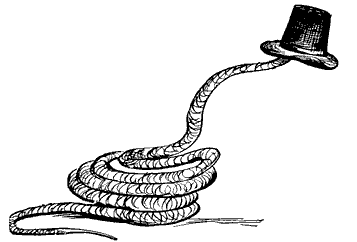
    This isn't particularly relevant,
    I just like snakes in hats, okay?
    There are a number of legends associated with Patrick - the two most frequently repeated ones are his use of the shamrock as an illustrative metaphor for the Holy Trinity, and that he banished all snakes from Ireland. It is this latter legend which frequently gets brought up in arguments over the so-called "pagan genocide" of the period.

    Let's make it clear - the account of Patrick chasing snakes into the sea should not be interpreted literally - though it may well have been at various times. Indeed, the general consensus is that Ireland never had any snakes in the first place, due to being geographically isolated since the last Ice Age, when it was too cold for snakes in any case. 

    Assuming a symbolic interpretation of the snakes thus seems like a reasonable assumption. Snakes, after all, have a long and convoluted symbolic history; in the context of Christianity, they are most frequently interpreted as symbols of sin, temptation, and all kinds of malevolence. The standard interpretation is, therefore, that Patrick's driving of the snakes from Ireland symbolically represents the overthrow of the pre-Christian paganism that existed before his coming. This particular interpretation has in recent years developed a great deal of traction within various pagan communities - it taps into a sense of persecution and heroic resistance to colonial aggression which elevates the struggles of a community towards acceptance to the level of myth. Which would, given the embarrassingly white nature of most modern pagan groups, be perhaps a little bit problematic if the original injustice didn't happen.

    Which, err, it didn't. At least, not in the apocalyptic way that it is sometimes presented.

    There seem to be an unusual amount of
    snakes in Santa hats on the internet
    The legend of Patrick's expulsion of the snakes seems to be traceable back to Muirchú moccu Machtheni's "Vita sancti Patricii", written some two hundred years after Patrick's time; this text depicts Patrick as something of a warrior-saint, deposing kings and battling druids, overthrowing pagan idols and miraculous feats inspiring mass conversion. These accounts - which often contradict the accounts of Patrick himself in his few surviving writings - have a lot in common with the legends of Christian saints found in the conversion of the Roman Empire, as described in Ramsey McMullen's "Christianizing the Roman Empire". It should be noted that the "Snakes = Druids" interpretation emerges almost entirely from this period; in "Blood and Misltetoe", Ronald Hutton remarks that the lack of references to the Druids with
    in Patrick's own writings, compared to the later heroic myths of the saint's life, suggest that these violent confrontations were given a greater degree of prominence - or invented wholesale - for the purposes of political hagiography. much later.

    An interesting example is that of Crom Cruach, a pre-Christian Irish god that St. Patrick is said to have destroyed the cult thereof. Crom is said to have been a solar-fertility god who demanded propitiation with human sacrifice to guarantee a good harvest. The tale of Patrick's destruction of the cult originates from the "Vita tripartita Sancti Patricii", a late 9th century text written partly in Irish and partly in Latin; Patrick is said to have struck down the idol of Crom Cruach and cursed the "demon" that appeared from within the idol. Other later texts repeat the tale in various forms, speaking of Patrick smashing the golden statue with a sledgehammer. And yet, this tale seems to reflect earlier tales of the god Lugh battling with, and being victorious over Crom Cruach, thus securing the harvest for the year, as outlined in Maire MacNeill's "The Festival of Lughnasa". One could see this as evidence of "Interpretatio Christiana", the syncretic equivocation of pagan archetypes and symbols with Christian ones, much in the same fashion that the Roman state paganism incorporated the gods and legends of the lands conquered by the Empire.

    I may have a problem (CN: contains snakes)
    So, what exactly did happen during the Christian conversion of Ireland? Well, for a start, the tale of Patrick being the first Christian missionary to the island is deeply inaccurate - records from the time of Pope Celestine speak of Palladius being sent as a bishop to minister to Christians in Ireland in 430, likely to stamp out the heresy of Pelagianism. Palladius is often erroneously conflated with St. Patrick, which becomes a source of great confusion, especially given the difficulty in dating Patrick's life or mission. There is a school of thought that suggests that there may have been a deliberate attempt to downplay the role of Palladius in the Christianisation of Ireland by the followers of Patrick, though this is difficult to prove either way with any certainty. In any case, it seems reasonable to assume that Christianity had already reached Ireland before Patrick's missionary efforts, due to the numerous connections between Ireland and Romanised Britain.

    One of the major difficulties here is in the fact that the vast majority of writings on pre-Christian Ireland come from much later sources, inevitably written by Christian monks and burdened with a rather predictable set of biases and dubious scholarship. However, what can be seen is a combination of a "top-down" conversion strategy, in which local kings would tend towards having their sons baptised, but not converting themselves; and a gradual increase in the political and economic influence of the monasteries, which became practically akin to local warlords in their own right. Over generations, the trend seems to have been towards assimilation and gradual conversion - albeit with remnants of the pre-Christian religion being syncretised and preserved in the cultural memory as a kind of folklore.
    "The doctrine of original sssin isss clearly Manichaeisssm"

    One final thought on the snakes. It is worth noting the frequency with which the Pelagian heresy is described with the metaphors of serpents, as in Rhigyfarch's "Life of St. David", written in the 11th century. Could the tale of St. Patrick's expulsion of the snakes be, perhaps, a reference to Palladius' original mission in Ireland?